 Festival Flamenco à Nîmes
(January)
This festival, held at the Théâtre de Nîmes, attracts the great masters of Spanish flamenco dancing, as well as guitarists and singers. Come to enjoy performances of this exciting and romantic Andalusian art form. (Tickets are required)
Le Poulain de Pézenas
(Festival held for 3 Days preceding Lent)
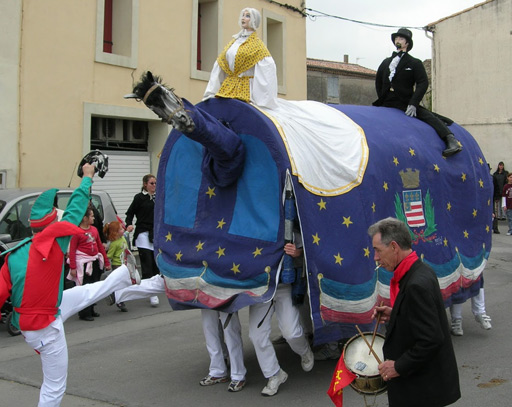
Like several of the surrounding towns and villages, Pézenas has a "totem animal"; in this case a huge horse called Le Poulain (lo poulain or lo polin in Occitan), which means "the colt". It makes appearances at festivals and parades throughout the year, especially for the Le Poulain de Pézenas celebration preceding Lent. Le Poulain is said to commemorate a visit to the town in 1226 by Louis VIII, during which the king's favorite mare fell ill. She had to be left behind in Pézenas while Louis continued with the Albigensian Crusade. On his return he was astonished to find that not only was his mare now fully recovered, but she had also given birth to a fine colt, which was duly presented to him, adorned with ribbons. In return he decreed that the town should construct a wooden colt to be used to celebrate all its public festivities. The first mention of the custom is in 1615.
Medieval Festival in Sommieres
(First weekend in April)
The first weekend in April each year, this beautiful town comes alive with a street festival featuring costumed merchants, performers, music and street markets.
 Grands jeux romains à Nîmes (Great Roman Games of Nîmes)
(May)
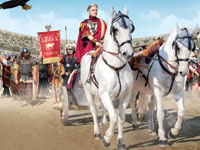
Held annually in Nîmes, this festival features events that highlight the age of the Roman Empire. Over 400 elaborately costumed re-enactors stage charriot races, gladiator fights, and mock battles. There are activities throughout the town, including in the Arènes de Nîmes, the historic Roman amphitheater.
Festival National de Theatre Amateur in Narbonne
(Late June/Early July)
Nightly performances are held on the Cours de la Madeleine at the Archbishop's Palace.
 Fête de la St-Pierre in Sète
(First weekend in July)
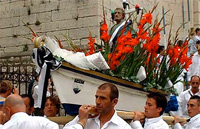
In early July, on the feast day of St. Peter, patron saint of fisherman, the residents of Sète come together to honor those who have been lost at sea, and ask for protection for those who make their livelihood on the water. A parade carries a statue of St. Peter through the streets, then aboard a boat which is joined by a procession of fishing trawlers festooned with flags and flowers. After the procession there is a water jousting tournament. Mix this in with the delicious local seafood, and an ample supply of rosé to wash it down, and it is impossible not to have a fabulous time.
 Bastille Day
(July 14th)
Bastille Day is celebrated nation-wide in France, with fireworks displays, parades, music, and other events. Carcassonne is one of the more spectacular locations to watch the fireworks lighting up the night sky over the ramparts of the historic walled cité. Narbonne also features an excellent Bastille Day pyrotechnics display, along with a four day celebration in the Cours Mirabeau.
Festival de Radio-France in Montpellier
(held annually in July)
This international music festival features all music genres from classical to jazz. Events and live performances are held at various venues across the city.
 Fiesta de Sète
(Late July/Early August)
The Festival de Sète is a two-week long Mediterranean music festival covering folk and pop music from North Africa and Europe. The festival takes place in late July to early August. There is plenty of street theatre and parties going on, as well as nightly performances in the Theatre de la Mer.
Beaucaire Medieval Fair
(4th week of July)
Beaucaire is famous for its annual Medieval fair held annually since 1217. The fair was originally established to commemorate a famous victory against Simon de Montfort's forces. At its height this fair would attract over 300,000 people.
Festival d'Avignon
(mid-July)
The Festival d'Avignon is a 'can't miss' for lovers of theatre, dance and contemporary art, considered a major event, and a must see on the French theatrical calendar. The Festival d'Avignon draws the attention of professionals and amateurs from all over the world, and has over the years amassed a large number of faithful observers and commentators from France and abroad.
 Grand Prix de la Saint-Louis à Sète
(End of August)
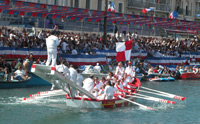
Every year at the end of August the Grand Prix de la Saint-Louis à Sète, the unofficial world championship of water jousting, is held in conjunction with the festival of Saint Louis. Competitors must be invited by the city to participate. The sport of water jousting (les joutes languedociennes) is an important element of local culture. Tournaments are held from April to September on the Canal Royal in the center of town, and are the highlight of the summer festivals. The competition involves two wooden row boats, one blue and one red, manned by a team of rowers. The jousters, wielding wooden lances and shields, are positioned on a raised platform (la tintaine) at the stern of the boats. The boats are rowed toward each other, and as one would expect, the jousters attempt to dislodge each other from their platform, sending the loser for a swim in the canal.
 Fête du Cassoulet de Castelnaudary
(Late August)
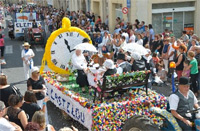
Castelnaudary has a massive week-long festival to celebrate cassoulet, the traditional dish of duck, sausage, white beans and duck fat said to have originated in Castelnaudary. Festivities include canal sports, live bands, dancing, street entertainers, and of course, cassoulet. Main street is taken over by tents with long trestle tables where everyone enjoys this local specialty.
La Feria in Beziers
(Late August)
Some say this is the greatest Languedoc festival. Beziers comes alive in spectacular fashion with fireworks, street entertainment, and a daily Spanish corrida. This is also an important wine festival.
Le Grau/Port Camargue
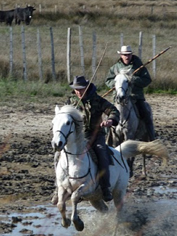
This fête includes bull-running through the streets, Camarguaises horsemanship, and water-jousting, together with lots of street parties and all-around merry-making.
Les Primeurs d'Oc in Beziers
(October)
The premier wine festival of the Languedoc, Les Primeurs d'Oc in Beziers features wine contests and awards, together with music, dance, and theater.

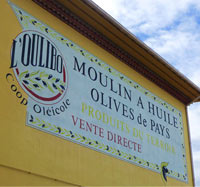 A Visit to the Olive Mill
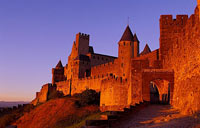 Historic Cité de Carcassonne is a UNESCO World Heritage site. The city rests on a hill overlooking the Aude Valley, and has served as a fortified settlement since prehistoric times. Carcassonne occupies a strategic location, along the ancient routes linking the Atlantic and Mediterranean. It was been held by or ruled over by many different groups throughout history. The earliest occupation of the site dates to the 6th century BC. Romans fortified the hilltop around 100 BC and occupied the area until the fall of the Roman Empire in western Europe. The fortification was taken over in the fifth century by the Visigoths, who founded the city. Carcassonne gained notoriety in the 13th century as a stronghold of Occitan Cathars, before they were defeated by Simon de Montfort.
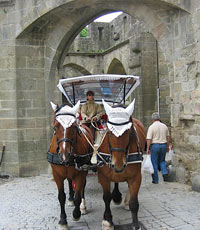 Today Carcassonne provides a wonderful experience for visitors who walk the narrow, car-free streets and tour the restored battlements at the heart of the old city. Carcassonne is home to several one- and two-Michelin-starred restaurants, an abundance of cafés, as well as enough boutiques and shops to fill the afternoon with exciting retail opportunities. For a unique before- or after-cruise stay, try one of the hotels located within the walls of the old city.
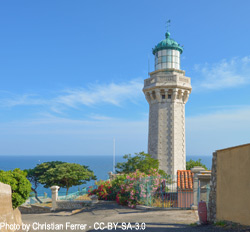 Located where the Canal du Midi meets the Mediterranean, Sète occupies part of a narrow spit of land that separates the Étang de Thau, a natural saltwater lake, from the Mediterranean sea. This is a working port, with a large percentage of the inhabitants involved in the fishing industry. Although Sète doesn't try to be a top tourist destination, this very fact makes it a refreshing place to visit and wonderful opportunity to surround yourself with the unspoiled local culture.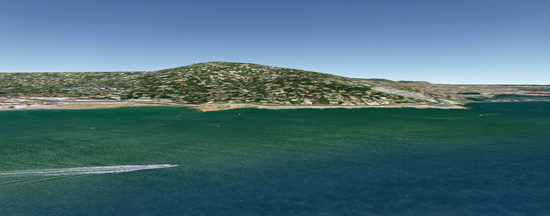
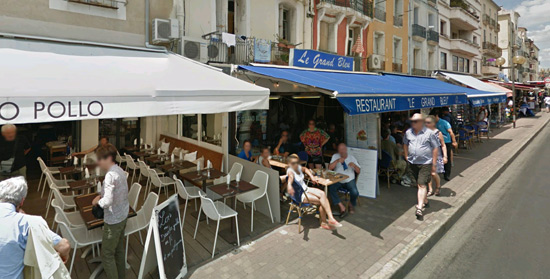
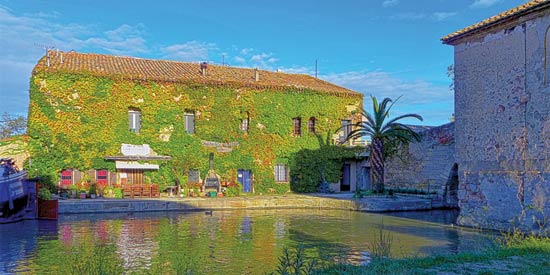

 This restaurant is a favorite of foodies who come here to enjoy the best locally sourced organic meats and produce the area has to offer. All meals are freshly prepared by Le Comptoir Nature's four local French women chefs, using ingredients procured daily: daurade picked up at the Narbonne fish market, magret de canard, lamb, and pork from farmers in the nearby Pyrenees, and wonderful fresh seasonal vegetables. There is even a vegetarian plate on the menu, a rarity in these parts. The artisanal ice cream is made from ewe’s milk - delicious! Le Comptoir Nature offers a selection of fine organic wines. Enjoy a bottle to accompany your meal, or sip a glass sitting at one of their small tables alongside the canal, watching the barge traffic and being entertained by the geese and ducks all around. Jazz ensembles or a funky brass band perform on Wednesday and Friday evenings, making for great fun. Prices are very affordable with 3- and 4-course meals ranging from €17.50 to €32.
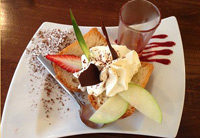 L’Auberge is the 'new' restaurant in Le Somail, having opened with its current owners two years ago. Locals often come here for birthday celebrations or other special occasions. It offers an elegant dining room and an outdoor canal-side terrace. The chef here draws from Languedoc's proximity to Spain, borrowing several dishes from the Spanish, such as paella and gaspacho. There are plenty of typically French favorites, too: a delicious melted goat cheese salad, foie gras, and a homemade cassoulet among them. This is the only restaurant in Le Somail that offers this succulent and rich regional dish made with white beans and duck confit. There is great debate as to exactly where cassoulet originated. Carcassonne, Castelnaudary and Toulouse all claim ownership, and there is a confrerie of cassoulet chefs still arguing over the recipe and it's origin. One thing that is agreed on is that the beans have to be AOC from the Aude region. Prices range from €23 to €25 for a three course menu, or order a la carte from their large selection.